




Unit 2: Resistance and Resilience: Art as Tool of Resistance
Time Frame
- 1–2 class periods
Materials
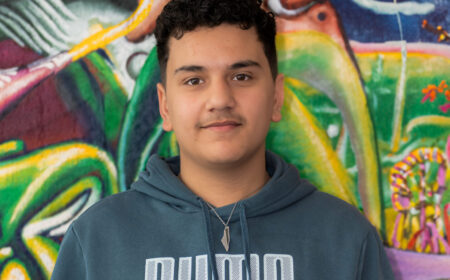
- Green Card Entrepreneur Voices – Dario Meija’s story
- Slides
Connections to the 7 Cs of Ethnic Studies
- Center: centering knowledge from community, elders, families and lived experiences.
- Connect: learn about Mexican and Latino resistance movements locally and globally, historically and today
Instruction
Day 1 – Ignite: Intro/Warm-Up
Welcome, agenda, announcements, learning target (slide 1)
a. Warm-Up Question: When was a time you overcame a fear or hardship?
i. Write in a notebook! (2-3 minutes)
ii. Turn to a neighbor and share (2-4 minutes)
iii. Share out to the class; pick a few students to share (2-3 minutes)
b. Mental health: Today’s lesson discusses racism and experiences of exclusion within Latine communities. Some may personally connect to these experiences in different ways. Please take care of yourself; participate in ways that feel comfortable and respectful.
Chunk: Resistance and Resilience—Latinos Are NOT a Monolith
c. Vocabulary (slide 2)
i. Vocabulary: Monolithic Thinking (slide 2) (source)
-
-
-
- “the tendency to view cultures, experiences, and people from a single perspective”
- Oftentimes, people believe that all Latino/a/x people have the same culture, experiences, traditions or beliefs. But from country to country, and even within countries, Latino/a/x people are so different!
-
-
d. Example: Latino/a/x are not a monolithic group, even within one country!
i. Slide 3: Afro-Latinos: people with descendants from Africa (source)
-
-
- Watch: https://www.youtube.com/watch?v=1XmfL62xozI
- As students watch, have them think/answer: What is something that Black Mexican people want non-Black Mexican people to know?
- Pick 2 people to share with the class.
-
ii. Slide 4: Indigenous people: native peoples to the land prior to European colonization
-
-
- Watch: https://www.youtube.com/watch?v=tQ9Uwq5kXY8
- As students watch, have them think/answer: What is something that indigenous people in Mexico are fighting for?
- Pick two people to share with the class.
-
iii. Puerto Rico is technically a US territory, but its rich cultural history makes it distinct from the rest of the United States.
-
-
- Ask students: Let’s make a list of things you think of when you think of Puerto Rico. (Have students shout out their answers and write a list on the board; Bad Bunny is likely to appear on this list.)
- There may be lots of buzz around these ideas, but for many years, Puerto Rico has wanted to establish independence from the US—all the way back to the early 1900s.
- Today, even stars like Bad Bunny are calling attention to the ongoing issues that Puerto Rico faces, like environmental disasters due to climate change and the economic/social inequalities people face there, despite being a part of the “exceptional” US.
a. Play Bad Bunny’s “El Apagon – Aqui Vive Gente.” (Disclaimer: It does have swearing in Spanish, and maybe some explicit dancing. Watch to see what scenes are most appropriate for students prior to showing it.)
-
iv. Slide 5: Art as a form of resistance and resilience
1. Places all around Latin America have different movements of resistance and resilience.
a. Ask students: How did Bad Bunny use art to call attention to what happens in Puerto Rico? (This could be your exit ticket, after which you continue with the next part tomorrow.)
2. Dance, music, attire, culinary arts, and more!
v. Recap: Latino/a/x are not a monolithic group, even within one country!
1. Even within Mexico, people come from all sorts of different racial and even cultural backgrounds. (Break text, new paragraph/line.) Now imagine we expand this map by thousands of more miles! (Insert map of Central and South America, including islands in Caribbean.)
Day 2 – Chew: Resistance and Resilience in Our Identities and Intersectionality (slide 6)
e. Class work time instructions
i. “So what happens when you have many identities—what do we do to honor all of them?” (slide 6 still)
f. Slide 7: Part 1: Pick a partner
i. Read the story of Dario Meija (have them printed).
ii. Annotate Dario’s story.
-
-
-
- Circle words you do not know.
- Highlight sections where Dario shares parts of his story that were hard/difficult for either him or his family.
- Underline sections where Dario shares parts of his story that honor his identities or bring him joy.
- Star sections that demonstrate identities (gender, culture, language, race, etc.).
-
-
g. Slide 8: Part 2: Add a pair to your pair!
i. Share your annotations and discuss reflection questions together.
ii. Partner Discussion Questions (record or walk around during this)
-
-
- Pick an annotation that stuck out to you—why did it impact you?
- What are some ways Dario finds joy in his Ecuadorian identity?
- How does Dario’s cultural and racial identity impact his work?
- Why does Dario share his story?
- In what ways does Dario demonstrate resilience?
-
Review: Large group whipshare discussion (can be expanded if time allows) (slide 9)
iii. What can resistance and resilience look like?
Resource List
- Contextual resources for further learning on topics of colonization in Latin America https://latino.si.edu/learn/latino-history-and-culture/latino-history/early-latino-history https://timemaps.com/civilizations/latin-america-the-colonial-era/
- Contextual resources for further learning on the Spanish Caste system www.indigenousmexico.org/articles/understanding-the-mexican-casta-system-a-historical-and-cultural-perspective
- Contextual resources for further learning on anti-Blackness in Latin America https://bookshop.org/p/books/racial-innocence-unmasking-latino-anti-black-bias-and-the-struggle-for-equality-tanya-kater-hern-ndez/8232518903b7c4be?ean=9780807020135&next=t&, https://www.abfe.org/blog/confronting-colorism-and-anti-blackness-latinx-community
- Contextual resources for indigenous erasure in Latin America www.oah.org/process/arena-indigenous-caribbean www.researchgate.net/publication/393269447_Latin_American_Mestizaje_A_Tool_to_Erase_the_Indigenous
- “Diversity Matters: Dismantling Monolithic Thinking to Create an Inclusive Work Environment” www.culture-principles.com/diversity-matters-dismantling-monolithic-thinking-to-create-an-inclusive-work-environment
- “Resistencia Afroamericana: La Historia de Yanga” www.youtube.com/watch?v=FIqLzOtzFp4
- Further learning for capoeira, a Brazilian martial art/dance form www.upr.org/arts-and-culture/2016-08-30/roots-of-brazil-the-martial-art-form-capoeira-is-preserving-history-and-tradition
- Further learning for mole https://laroussecocina.mx/palabra/mole www.gob.mx/inpi/articulos/conoce-la-maravillosa-historia-del-mole
- “Colombia: Top Local Music That Reflects the South American Country’s Culture and Tradition” www.latinpost.com/articles/154478/20220315/colombia-top-local-music-reflects-south-american-culture-tradition.htm
- Liberated Ethnic Studies Model Curriculum Values and Principles (7 Cs) https://drive.google.com/file/d/1cGOs7rsY9wT2qI-yIQh5dye8snRjGYxr/view