
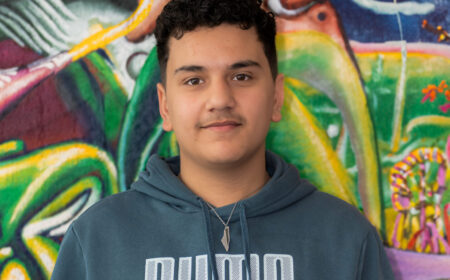



Unit 1: Identity and Language – Identity Through Language: Ashti’s Story
Time Frame
- 2 class periods
Materials
- Green Card Youth Voices: Immigration Stories from a Fargo High School – Ashti Mohamed Ali’s story and video
- Highlighter
- Pencil and Notebook
- Vocabulary and Definitions Handout
Connections to the 7 Cs of Ethnic Studies
- Cultivate: learning about how Arab American history, people, and language provide opportunities for identity affirmation and healing
- Celebrate: using Arab American counter-stories and community narratives through storytelling
Instructions
Day 1 – Identity, Language, and Background Knowledge
Ignite: Interactive/Interpersonal Activity
Show two visuals of multilingual students and classroom communication challenges.
- Ask students:
- What language do you speak at home?
- When do you feel like you belong?
- How would you feel if people could not understand your language?
Turn and Talk
Use sentence starter: “I would feel ___ because ___.”
- Invite two or three students to share with the class.
- Write key feeling words on the board (frustrated, scared, invisible, proud, confused, excited).
Tell students: Today we are going to meet a young woman named Ashti, whose story is connected to many of these feelings.
Vocabulary Introduction
Distribute the Vocabulary and Definitions Handout before watching Ashti’s video. Review each word and example. Students should keep the handout on their desks during all activities.
- Say the word aloud; students repeat.
- Read the definition in simple words.
- Give a real-life example.
- Students turn and tell a partner what the word means in their own words.
Cultural Background
Iraq is a country in the Middle East with a rich and ancient history. Baghdad, where Ashti was born, is the capital city and one of the oldest cities in the world. Iraq is home to many different ethnic and religious groups, including Arabs and Kurds.
The Kurdish people are an ethnic group with their own language (Kurdish) and culture, found primarily in northern Iraq, Turkey, Iran, and Syria. Many Iraqi and Kurdish families came to the United States as refugees or immigrants, often fleeing violence, war, or political persecution. Minnesota and cities like Fargo, North Dakota have significant Iraqi and Kurdish communities. These communities have brought rich cultural traditions, languages, food, music, and values to the United States.
The name Ashti (آشتی) means peace in Kurdish. Names in Iraqi and Kurdish culture often carry deep meaning connected to family history, values, or hopes for the future.
Chunk: Interpretive Activity (Viewing/Listening)
Watch Ashti’s video. Tell your students to watch without writing, and just focus on understanding the story.
- Pause and ask yes/no questions:
- Did Ashti speak more than one language? (Yes / No)
- Was language easy for her at first? (Yes / No)
- Did language affect how she felt? (Yes / No)
- Optional cultural connection video before reading:
- Show a short video (3-5 minutes) connected to Iraqi/Kurdish culture, family traditions, language, or daily life experiences to help students build background knowledge before reading Ashti’s story.
Examples:
- Iraqi/Kurdish family traditions (https://www.youtube.com/watch?v=wgyBqgFwksg)
- Multilingual experiences
- Arab hospitality and community life
- Immigration and identity experiences
Exit Ticket
- What is one way language connects to identity?
- What is one thing you learned about Iraqi/Kurdish culture or multilingual experiences?
Day 2 – Ashti’s Story and Identity Reflection
Warm-Up Review
Quick partner review:
- What do you remember about Ashti’s story?
- What challenges did she face?
Chunk: Reading & Organizer Activity
Read Ashti’s story together or with a partner.
Draw the graphic organizer chart on the whiteboard as seen below, then fill it out using words or short phrases. Complete one example together as a class before students work independently.
| Challenge | Action | Outcome |
Chew: Interpersonal Activity (Partner Talk)
Partner Questions
- What language challenge did Ashti have?
- How did language make her feel?
- Why is language part of identity?
- How did Ashti stay connected to Iraqi culture and family?
Sentence Stems
- Ashti felt ___ when she used ___ language.
- Language is part of identity because . . .
- Stand – Share – Switch
- Iraqi culture is important to Ashti because . . .
- I feel connected to my identity when . . .
Stand – Share – Switch
After partner discussion, do a Stand–Share–Switch:
- Students stand up and share one idea from their discussion with a new partner.
- Switch partners and share a different idea.
- Return to seats and write one sentence they heard from a classmate that they want to remember.
Students may:
- discuss with partners
- draw
- write short responses
- orally share ideas
Example questions:
- What language do you hear at home?
- What foods remind you of family/community?
- What traditions are important in your home?
- What music, clothing, or celebrations are important in your culture?
Review: Presentational Activity (Writing or Drawing)
Students may choose writing, drawing, or oral sharing to show understanding.
Option A: Writing (Short)
Sentence starters:
- Ashti speaks . . .
- Language makes her feel . . .
- I learned that identity is . . .
Option B: Drawing + Sentence
- Draw one moment from Ashti’s story.
- Write one sentence below the picture.
Student Personalization
Students connect to their own experiences:
- Do you speak more than one language?
- When do you feel included or left out?
Exit Ticket (2 minutes)
Student answers:
- One thing I learned today about identity, language, or belonging is . . .
Multilingual and ELL Support
- Visuals and pictures
- Sentence frames
- Partner support
- Oral answers accepted
- Drawing instead of long writing
- Teachers check for understanding before independent writing
- Optional oral responses before written responses
Resource List
- Green Card Youth Voices: Immigration Stories from a Fargo High School – Ashti Mohamed Ali’s story and video
- Background Context on Baghdad, Iraq
- Liberated Ethnic Studies Model Curriculum Values and Principles (7 Cs) https://drive.google.com/file/d/1cGOs7rsY9wT2qI-yIQh5dye8snRjGYxr/view
Vocabulary and Definitions Handout
| Vocabulary Word | Definition | Example |
| Belonging | The feeling of being accepted, valued, and “at home” within a group or community | Feeling like you are welcome and understood by people around you. |
| Identity | The mix of qualities, beliefs, and history that makes a person who they are. | Your name, your language, your culture, your family—these are all part of your identity. |
| Culture | A shared way of life—including traditions, food, language, and beliefs—passed down through generations. | The food your family eats, the holidays you celebrate, the language you speak at home. |
| Challenge | A difficulty or problem that takes effort to overcome. | Learning a new language in a new country can be a challenge. |
| Language | The specific words, sounds, or symbols a group uses to share ideas and connect with one another. | Arabic, Kurdish, English, Spanish, Oromo, Hmong, etc. |
| Name | The word or title used to identify a person—often carries family history or special meaning. | The name Ashti means peace in Kurdish. |
| Feeling | An inner emotion—like pride, sadness, or excitement—that arises in response to an experience. | Feeling proud when someone recognizes your culture. |