



Unit 3: Healing After Displacement: Zaynab’s Journey Toward Identity and Justice
Time Frame
- 2 class periods
Materials
- Green Card Youth Voices: Immigration Stories from a Minneapolis High School – Zaynab Abdi’s story and video
- Voice for Refuge
- Pencil and Notebook
- Vocabulary and Definitions Handout
Connection to the 7 Cs of Ethnic Studies
- Challenge: move toward learning that interrupts harm; advances justice toward action, organizing, advocating, and healing; and disrupts dominant narratives
Instruction (ICCR)
Day 1 – Understanding Zaynab’s Story and Context
Ignite: Interpretive Activity (Viewing/Reading)
Ask students to think about a time when something was difficult for them.
Have each student choose one theme to write about:
- Talk about a time when you had to be strong.
- Have you ever moved to a new place or started something new? How did you feel? What did you do?
Allow 3-5 minutes for writing
Remind students that healing does not mean forgetting difficult experiences. Healing can include finding support, community, purpose, hope, and belonging
Chunk: Historical and Cultural Context
Yemen is a country in the Middle East, located on the southern tip of the Arabian Peninsula. It is one of the oldest inhabited regions in the world, with a rich history of trade, culture, and civilization. Aden, where Zaynab grew up, is Yemen’s second-largest city and a major port.
In 2011, Yemen experienced a major political revolution as part of the broader Arab Spring movement. This led to years of civil war and conflict, making Yemen one of the most dangerous places in the world for civilians. Millions of Yemeni people have been displaced and forced to leave their homes because of the violence.
Many Yemeni families, like Zaynab’s, were separated by the conflict. Some fled to neighboring countries like Egypt or Jordan. Others eventually made it to the United States through the refugee and immigration system.
Somalia is a country in East Africa, in the Horn of Africa region. Many Somali families have also immigrated to Minnesota; Minneapolis has one of the largest Somali communities in the United States. Zaynab’s story connects to this broader community of East African and Arab immigrants who have built new lives in Minnesota.
TB (tuberculosis) is a serious infectious disease that affects the lungs. It is common in parts of Africa, the Middle East, and Asia, particularly in overcrowded or under-resourced conditions. Zaynab contracted TB while living in Egypt. She received treatment and recovered. Her survival and continued journey show remarkable resilience.
STEP-UP is a real youth employment program in Minneapolis that connects young people, many of them from immigrant and refugee families, to internships, job training, and career opportunities. It is one of the many programs in Minneapolis that supports new immigrants and refugees in building their futures.
Briefly Introduce:
- Somalia, Yemen, Egypt
- Refugee experiences
- Somali communities in Minnesota
Show:
- Map of Somalia, Yemen, Egypt
- Timeline of Zaynab’s journey
- Photos of Somali community life
Vocabulary Introduction
Distribute Vocabulary and Definitions Handout before viewing Zaynab’s video. Review each word, discuss the definition, “Connect It” statement, and Critical Question. Students should keep the handout on their desks during all activities.
Arabic Language Connection
Introduce simple Arabic words related to the lesson:
- سلام (Sah-LAM) – Peace
- أمل ((AH-mal) – Hope
- مجتمع (Muj-TA-mah) – Community
- قوة (QOO-wah) – Strength
Practice pronunciation and discuss how these ideas connect to healing and future building.
Prepare for Viewing
Tell students their job is to listen for:
- Challenges Zaynab faced
- Actions she took to overcome them
- Outcomes or opportunities that resulted
First Viewing
Tell students to watch without writing, and just focus on understanding the story.
After viewing, ask:
- Where did Zaynab migrate and why?
- What challenges did she face?
- How did she respond or show resilience?
- What opportunities came from her experiences?
Review: Exit Ticket
Complete one statement:
- One challenge Zaynab faced . . .
- One example of resilience is . . .
- One thing I learned about Zaynab’s journey was . . .
Day 2 – Healing, Advocacy, and Future Building
Warm-Up Review – Partner Discussion
- What do you remember about Zaynab’s story?
- What challenge did she face?
- Who helped support her?
- What does healing mean?
Chunk
Second Viewing
Play the video a second time. Draw the graphic organizer chart on the whiteboard as seen below, then fill it out using words or short phrases. Complete one example together as a class before students work independently.
Stop at certain timestamps of Hend’s video to help students.
|
Outcome or Opportunities |
Action or Resistance |
Challenge or Restriction |
Teacher Moves (Pause and Support)
- What challenges did Zaynab face?
- How did she respond or show resilience?
- What opportunities or outcomes came from her experiences?
Check for Understanding
Invite two students to share one challenge, action or outcome.
Chew: Interpersonal Activities (Speaking/Exchanging Ideas)
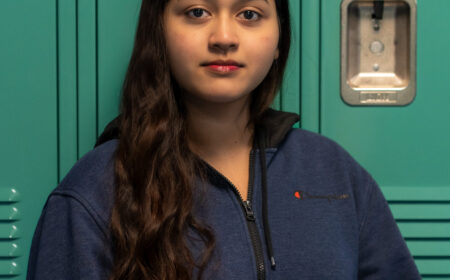
When Zaynab came to the US, she faced many challenges but also found new opportunities through education and community. She became a student leader, used her voice to speak about refugee experiences, and advocated for justice.
Partner Talk
Have students pair up with a partner to discuss and interpret Zaynab’s journey. How does her story show:
- Challenges or Restrictions?
- Action of Resistance or Resilience?
- Outcome of Opportunities?
Student Choice
Option A: Analyze Zaynab’s Story
Identify:
- The challenge
- The action
- The outcome
Option B: Make a Connection
Think about a person you know (or a famous person) who:
- Faced a challenge
- Took action
- Created opportunities
Draw a picture or explain their story.
Rather than focusing solely on hardship or trauma, encourage students to highlight:
- community
- healing
- hope
- belonging
- creativity
- family support
Sentence Stems
One challenge Zaynab faced was . . .
- She responded by . . .
- This led to . . .
- In my opinion, this shows . . .
Review
- Fill in the blank about resilience or resistance.
- I learned that resilience can be ___ because . . .
- In Zaynab’s story, resilience looked like . . .
Chew: Presentational Activities (Writing/Speaking) Review
Option A: Presentational Writing
- Explain how Zaynab’s story shows healing and future building. Use two vocabulary words.
or
- Present to a partner, then share with the class.
- Starter: “Zaynab’s story shows healing because . . .”
Option B: Presentational Speaking
- Each student presents for thirty to forty-five seconds.
- This matters because . . .
Review: Quick Assessment (Exit Ticket)
Answer one question:
- What is one challenge Zaynab faced? How did she respond?
- What is one way Zaynab showed resilience?
- What is one opportunity Zaynab gained from her experiences?
- How did Zaynab find support during difficult times?
- What role did the community play in her journey?
- How did Zaynab use her experiences to help others?
- What does healing mean in Zaynab’s story?
Sentence Stems
Healing can look like . . .
- The community helped Zaynab by . . .
- Zaynab used her voice to . . .
- Future building means . . .
- I learned that healing can include . . .
Multilingual and ELL Support
- Use sentence stems for discussions and writing, such as:
- One challenge Zaynab faced was ___, which led her to . . .
- She responded by ___, showing resilience because . . .
- One opportunity that came from this was . . .
- I learned that resilience can be ___ because . . .
- Zaynab’s story shows ___ because ___ . . .
- Allow the use of heritage language captions on videos.
- Include timestamps to help students fill out the graphic organizer.
- Allow discussions in students’ home language, then translate if needed.
- Allow any writing to be in the students’ home language first.
- Allow fill-in-the-blanks when writing, as needed.
- Model responses (think-aloud) before students respond independently.
Resource List
- Green Card Youth Voices: Immigration Stories from a Minneapolis High School – Zaynab Abdi’s narrative and video
- Voice for Refuge https://drive.google.com/file/d/1_BACmQtwiM7t7wpGM-eqf6tqOf3k3msd/view
- Liberated Ethnic Studies Model Curriculum Values and Principles (7 Cs) https://drive.google.com/file/d/1cGOs7rsY9wT2qI-yIQh5dye8snRjGYxr/view