


Unit 2 Resilience and Resistance – Resilience in the Oromo Culture
Time Frame
- 2 class periods
Materials
- Green Card Entrepreneur Voices – Tashitaa Tufaa’s video
- Appendix: Student Handouts
- Oromo lesson slides
Connection to the 7 Cs of Ethnic Studies
- Center: centering the Oromo indigenous culture of helping each other
Instruction (ICCR)
Day 1 Warm-Up Question
- Think about a time someone helped you without you asking. What did they do? How did it make you feel? Write two to three sentences or draw a picture.
Ignite
- Ask students the following questions. (Students can answer in English or a heritage language. They can also draw their answer, if they’d like.)
- What do you think culture means? If it helps, you can describe our classroom culture, our school culture, your family or community’s culture, our culture in America, etc.
- What do you think resilience means?
- Have students share their answers.
Chunk 1
- Give a student-friendly definition of culture and resilience.
- Provide the lesson on Oromo culture below.
The Oromo Culture of Helping Each Other
- Jiga is when people come together to help each other with work. Everyone shares the effort so no one has to do it alone.
- The focus is on teamwork and shared responsibility.
- Qabo is when people quickly show up to help someone they care about who is in trouble, without needing to be asked.
- The focus is on community being there whenever it’s needed.
- Afoosha is when a group of people regularly support each other, especially during emergencies, by sharing money or resources.
- The focus is on financial and social support.
Chunk 2
- Give a scenario of a student at school who recently traveled from Ethiopia to the US. Ask the following questions:
- What challenges do you think this student would have with class, lunch, friends, and recess? (Expected answers include the language barrier, not knowing where to go for class/lunch/recess, and difficulty making friends.)
- Knowing what our school is like, how do you think students would react to their new classmate? What kind of help do you think the teacher and school would provide?
- Given our lesson on Oromo culture, would our response be the same as that culture’s, or different?
- Jiga: Who would be responsible for helping the new student get to classes? Learn English? Get resources for the family?
- Qabo: Do you think our school is ready to help this student in their time of transition?
- Afoosha: What role can our school play in providing this student and their family with resources and support to help them transition to a new country?
Exit Ticket
- Name one of the three Oromo cultural values we learned today (Jiga, Qabo, or Afoosha) and explain what it means in your own words.
- The value I remember is ___. It means ___.
Day 2 Warm-Up Question
- Think about Tashitaa’s story. What is one challenge he faced when he arrived in the USA? How do you think the Oromo cultural values could have helped him? Write one to two sentences.
Chew
- Watch Tashitaa Tufaa’s video
- Turn and Talk, sharing with a partner:
- What Oromo culture did Tashitaa mention?
- How did he use his Oromo cultural upbringing to persevere when he was learning English, working multiple jobs, and starting his own business?
- In small groups or with a partner, fill out the Student Worksheet (see attachment/appendix 2) with suggestions for what community help could have looked like for Tashitaa if the Oromo cultural system had been centered when he arrived in the USA. Refer to the slides from this lesson. If needed, you can refer to the handout “Why Is Oromo Culture Important?” (attachment/appendix 1).
Review
- Have students summarize what the Oromo culture means to them. How could we use aspects of Oromo culture and justice systems in our classrooms, schools, and society?
- Ask students how their family is the same or different from the Oromo culture when it comes to responsibility for caring about the needs of others.
Exit Ticket
- One Oromo cultural value I want to bring into my school or community is ___ because ___.
Multilingual and ELL Support
- Provide visuals (see slides/attachments).
- Provide sentence stems for written work and verbal share-outs / small group discussions.
- Provide captions for the video.
- Provide Tashitaa’s text in students’ home language, if needed.
Vocabulary and Definitions
- Culture: A reflection of how people live and exist as a community or nation. Culture includes many parts of life, such as politics (how people are governed), religion (belief systems), traditions (customs and practices), and the economy (how people work and support themselves).
- Resilience: The ability to keep going and not give up when things get hard.
- Guuza/Jiga (JEE-guh): When people come together to help each other with work. Everyone shares the effort, so no one has to do it alone. The focus is on teamwork and shared responsibility.
- Qabo (KAH-boh): When people quickly show up to help someone they care about who is in trouble, without needing to be asked. The focus is on the community being there whenever you need it.
- Afoosha (ah-FOO-shah): When a group of people regularly support each other, especially during emergencies, by sharing money or resources. The focus is on financial and social support.
Resource List
- Oromo images https://docs.google.com/presentation/d/1K4aniJlR0OMvZZkDZT-LIHKTRxnoBA5Ah09EV0Tb758/edit
- Liberated Ethnic Studies Model Curriculum Values and Principles (7 Cs) https://drive.google.com/file/d/1cGOs7rsY9wT2qI-yIQh5dye8snRjGYxr/view

Unit 2: Resilience and Resistance – Hmong Resilience and Resistance
Time Frame
- 1–2 class periods
Materials
- Hmong Politicians Profile Assignment worksheet
- Green Card Entrepreneur Voices – Bo Thao-Urabe’s story
- Hmong Town Marketplace and Hmong Village images
Connections to the 7 Cs of Ethnic Studies
- Celebrate: using Hmong counter-stories and community narratives through storytelling
- Challenge: understanding how Hmong individuals and organizations contribute toward action, organizing, advocating, and healing in their local communities
Instruction (ICCR)
Ignite: Qualities for Success
- Display on the board an image of either Hmong Village or Hmongtown Marketplace in St. Paul, Minnesota.
- As students are looking at the visual, share with them:
- Hmong immigrants arrived in the US with nothing more than the clothes on their backs and simple pots and pans. Look at the bustling marketplace on the screen, and think of what qualities are needed for survival and success.
Turn and Talk
Ask students to brainstorm with an elbow partner what three qualities (bravery, hard work, etc.) they would need to survive and eventually open a store like the image on the screen, if they had to move to a new country with no knowledge of the language and no money.
- Ask a few students to share out loud with the class.
Chunk: Resilience
Acknowledgement: This was the shared journey for many Hmong Americans. There are other Hmong narratives that may contrast this one, such as Hmong Chinese, Hmong Laos, Hmong Vietnam, and other groups with their own different experiences. Some may have fought along with the communists or with the Pathet Lao for their own survival or by choice. Similarly, not all Hmong followed the refugee journey or chose to migrate to the United States, as many chose to remain in Laos and Thailand, and some even migrated to different countries throughout the world. This lesson will focus mainly on the shared experience of Hmong Americans.
Explain that the Hmong were an ethnic minority group from China. Throughout history, the Chinese and Hmong fought many wars against each other over land and resources. Eventually, Hmong fled China into Southeast Asia. In Laos, the CIA recruited the Hmong to help fight against communism and the Pathet Lao during the Secret War. They were recruited due to the Hmong being familiar with the land; many joined out of necessity to survive during wartime. When the US withdrew from the Vietnam War, they also abandoned the Hmong in Laos. The Hmong faced persecution and genocide by the Pathet Lao and had to fend for themselves in the jungles of Laos.
The journey to get across the Mekong River to Thailand was in itself a journey of resilience. The Hmong had to hide in the jungle, forage for food, travel in groups, and often move under the cover of the night sky to evade the Pathet Lao. Along the way, some had to abandon personal belongings, some had to leave behind family members, some elders had to be carried, some crying babies were drugged with opium to keep them silent when the enemy was nearby, and some babies did not make it. It was their mental and physical resilience that helped them to reach the river and to cross it into Thailand to gain their freedom. (Background Information)
- Resilience is the ability to get through an incredibly hard time and keep going.
- Quick Check-In: What is one example of how the Hmong showed resilience?
- The Hmong had to hide, travel at night, and look out for each other in the jungle to reach safety across the Mekong River.
Chunk: Resistance and Power
Transition from history to community, by introducing the clan system and political representation. Explain how Minnesota is home to over 90,000 Hmong immigrants, with St. Paul being the largest urban concentration in the US.
Cultural strength
- Explain how the clan system is a strength for the Hmong. Use a team analogy to help explain a clan; if one member of your team wants to start a business, everyone on the team pitches in to help.
- Turn and Talk: Who is a part of your clan, or “team,” or the people you can always count on?
- Connection to Resistance: Explain to the students that resistance doesn’t always mean fighting, and can also mean organizing to make sure your people or community have a voice and receive fair treatment.
Politics
- For a long time, the Hmong community in MN did not have anyone in city or state government who understood their history or culture. Hmong lacked political representation until Mee Moua came along in 2002. Mee Moua was the first elected Hmong state senator.
- Not only did she use her voice to make sure Hmong were heard, she also opened the door for Foung Hawj and others to follow, attracting Hmong Americans to participate in politics.
Chew: Bo Thao-Urabe’s Story
- Provide an excerpt from “Bo Thao-Urabe” from Green Card Entrepreneur Voices, pages 11–12.
- Have students read the passage of Bo’s experience with creating positive changes.
Group Task
- Paragraph and Summary: One partner reads a paragraph; the other summarizes the paragraph in 5 words. Switch halfway through the reading.
- Discuss and Analyze:
- Recall: What challenges did Bo face when she was growing up?
- Sentence Starter: Bo faced the challenge of . . .
- Concept: How did Bo use her resilience to help her start her own projects?
- Sentence Starter: Bo showed resilience by _____________; this helped her because ___________.
- Connect: How does Bo’s story show resistance, using her power to create a positive change for others?
- Sentence Starter: Her work created change for the community by __________.
- Recall: What challenges did Bo face when she was growing up?
Optional Extension Assignment: Hmong Politicians Profile Assignment
- Create a list of Hmong politicians; have students pick one to research and complete a worksheet on.
- Possible politicians: Kaohly Her, Fue Lee, Jay Xiong, Nelsie Yang, Samantha Vang, Mai Xiong, Susan Pha, etc.
- See the worksheet.
Review: Exit Ticket
Have students fill in the blank to answer this question prompt: “The Hmong community united together and drew on their strength of ______________________ to challenge ____________________, and created a lasting change by _____________________.”
Multilingual and ELL Support
- Provide a graphic organizer for the Hmong politician profile assignment.
- Provide sentence stems for reflection questions:
- A quality one would need is _______ because . . .
- I noticed that . . .
- I think / I believe Hmong American Day is important / not important because . . .
- I think many Hmong became interested/involved in politics because . . .
- We can celebrate / critique _______________ because . . .
Vocabulary and Definitions
- System: the organized way of doing something based on the way it was set up and meant to work
- Resilience: the ability to bounce back after a tough experience or time
- Clan system: a large extended family connected by both a shared last name and shared ancestors
- Change: the process of something becoming different than what it was before
- Politician: a person elected to help run a government and make decisions for the city, state, or country
- Entrepreneur: a person who starts their own business or projects to help solve a problem or provide goods or services
Resource List
- Green Card Entrepreneur Voices – Bo Thao-Urabe’s story
- Hmong Town Marketplace and Hmong Village images
- Secret War in Laos www.cvmuseum.com/explore/the-secret-war
- Liberated Ethnic Studies Model Curriculum Values and Principles (7 Cs) https://drive.google.com/file/d/1cGOs7rsY9wT2qI-yIQh5dye8snRjGYxr/view
Unit 1: Identity and Language – Roots of Oromo
Time Frame
- 2 class periods
Materials
- Green Card Youth Voices: Immigration Stories from a Minneapolis High School – Ikrem Nuru’s video
- Appendix: Student Handouts
- Oromo images (see pictures here)
Connections to the 7 Cs of Ethnic Studies
- Cultivate: learning about the Oromo history, people, and language to provide opportunity for identity affirmation and healing
- Center: centering Oromo youth and their lived experiences navigating institutional structures as new immigrants
Instruction (ICCR)
Day 1 Warm-Up
- What do you already know about the Oromo people or language? Write one thing, or write “I don’t know yet” if you are not sure.
Ignite
- Have students Turn and Talk and complete the KWL chart (see attachment/appendix 1) by answering the question below:
- What do you know about the Oromo people and language?
Chunk 1
- Provide a short reading and analyze the text of “Oromo People, Culture, and Language” (see attachment/appendix 2) with students to help students understand the history, culture and language of the Oromo people.
- Use “3-2-1 Close Reading Strategy” (see attachment/appendix 3), an activity where students identify three interesting facts, two connections, and one question.
Chunk 2
- Have students watch Ikrem Nuru’s video
Exit Ticket
- Write ONE thing you learned today about the Oromo people or language.
- “One thing I learned is ___.”
Day 2 Warm-Up
- What is one part of your identity that is important to you? It could be your language, your family, your culture, where you were born—anything. Write or draw it below.
Chew
- After watching the video, have students jigsaw together the timeline of events in chronological order from Ikrem Nuru’s story (see attachment/appendix 4).
- Have students create their own identity jigsaw puzzle by answering assorted themes/questions (see attachment/appendix 5).
- Event 1: Heritage and Roots
- Event 2: Major Changes
- Event 3: Challenges and Growth
- Event 4: Community and Belonging
- Event 5: Future Dreams
Review
- Have students share their identity jigsaw puzzle with a table partner. Afterward, ask them: What new information did you learn about your classmate?
- Then, have students complete the “What I Learned” column on the KWL chart.
Multilingual and ELL Support
- Provide visuals (see slides/attachments).
- Provide graphic organizers as student handouts.
- Provide sentence stems for written work and verbal share-outs / small group discussions.
- Annotate text using different colors for 3-2-1 close reading strategy.
Vocabulary and Definitions
- Boorana (Buh-RAH-nuh): one of the largest Oromo ethnic groups
- Barentu (Bah-REHN-too): branch of Oromo people
- Cushitic (Kuh-SHIT-ik): group of languages and peoples of the Horn of Africa
- Afaan: language
- Afaan oromo (AH-faan oh-ROH-moh): Oromo language
Resource List
- Book-Alamayyoo Haile, 2007
- The Oromo and the Christian Kingdom of Ethiopia, 1300–1700 by Mohammed Hassen
- Book – Hundasaa Waaq-woyya. 2013
- Partisan Discourse and Authentic History by Tabor Wami
- Oromo images https://docs.google.com/presentation/d/1K4aniJlR0OMvZZkDZT-LIHKTRxnoBA5Ah09EV0Tb758/edit
- Liberated Ethnic Studies Model Curriculum Values and Principles (7 Cs) https://drive.google.com/file/d/1cGOs7rsY9wT2qI-yIQh5dye8snRjGYxr/view
Unit 1: Identity and Language – Hmong Identity and Language
Time Frame
- 1–2 class periods
Materials
- Green Card Youth Voices: Immigration Stories from a St. Paul High School – Iya Xiong’s story and video
- T-Chart
Connections to the 7 Cs of Ethnic Studies
- Cultivate: learning about the Hmong history, people, and language to provide opportunities for identity affirmation and healing
- Celebrate: using Hmong counter-stories and community narratives through storytelling
Instruction (ICCR)
Ignite: Language
Write on the board:
Nyob zoo. Kuv lub npe hu ua . . .
(Hello. My name is . . .)
Ask students if anyone recognizes the language or can read it. Call on a few to guess or read it out loud. Ask students to raise their hands if they speak a language other than English at home.
Turn and Talk
Imagine if you were to move to a new country where no one speaks, reads, or understands your language. How would you tell them who you are? How would you tell your story?
- Ask a few students to share out loud with the class.
Chunk: Oral Tradition
Introduce the Hmong people as an ethnic minority group out of China who migrated throughout much of Southeast Asia. The CIA recruited Hmong to help with the Secret War in Laos, and as a result, many Hmong had to flee Laos into refugee camps in Thailand. Today, Hmong are scattered throughout the United States, with a massive presence in California, Minnesota, and Wisconsin. The Twin Cities are home to the largest concentration of Hmong. The Hmong identity has been shaped by a fight to retain their language and culture.
- Briefly explain the Hmong journey: China -> Laos -> Refugee Camps -> US
- Define “oral tradition”: history passed down by mouth, usually through storytelling, songs, or cultural practices, rather than reading through books.
Turn and Talk
When in school, students learn history by reading textbooks. Why is oral history just as important as textbooks?
- Ask for a few students to share out loud with the class.
Chunk: Hmong RPA
- Explain Hmong RPA (Roman Popular Alphabet), the most common Hmong writing system today. It was developed in the 1950s by French missionaries. RPA are the ABC’s that we know, but the Hmong written version just sounds different.
- Briefly explain that Hmong is a tonal language with eight tones. The final letter in a written Hmong word is usually not pronounced; it indicates the tone or vocal pitch, and each word has its own meaning.
- Show the students the word Hmoob (Hmong). Explain to them that the “b” at the end is silent; it is a tone marker, tells you only to say the word with the high tone, and acts like a musical note.
Turn and Talk
What might happen if you didn’t say the word Hmoob with a high tone, and instead said it with a lower or mid tone? How does language influence or affect one’s oral history?
- Ask a few students to share out loud.
Chew: Iya Xiong’s Story and Activity
- Provide a short excerpt from “Iya Xiong” from Green Card Youth Voices: Immigration Stories from a St. Paul High School, using the middle of page 3 to 4.
- Read the passage of Iya’s experience in America out loud to the class, and have them follow along.
T-Chart Activity
- Provide students with a T-Chart labeled Barriers on one side and Bridges on the other.
- Barrier – On this side of the chart, have students find and write about Iya’s experiences that made her feel lonely, confused, different, or challenged.
- Bridge – On this side of the chart, have students find and write about Iya’s experiences that made her feel proud, connected to her family, or positive.
- Students should identify at least 3-5 barriers and bridges each.
Group Discussion/Share
- How does Iya’s story add to the history of Minnesota?
Review: 3-2-1 Exit Ticket
On a slip of paper (regular notebook paper or sticky notes) or a digital form, students must write and turn in:
- Three things they learned about Hmong history or the language
- Two reasons why storytelling is important
- One question they still have about Hmong culture
Multilingual and ELL Support
- Provide sentence stems for class discussion and discourse.
- Provide students with the T-Chart.
Vocabulary and Definitions
- Oral tradition: history passed down by mouth, usually through storytelling, songs, or cultural practices, rather than reading through books
- Romanized Popular Alphabet (RPA): the Hmong reading and writing system that uses the same letters found in English
Resource List
- Green Card Youth Voices: Immigration Stories from a St. Paul High School – Iya Xiong’s story and video
- What is Hmong Oral Tradition? www.mochimag.com/arts-culture/hmong-oral-tradition
- What is Hmong RPA? www.hmongrpa.org
- Hmong History Timeline www.mnhs.org/hmong/hmong-timeline
- Liberated Ethnic Studies Model Curriculum Values and Principles (7 Cs) https://drive.google.com/file/d/1cGOs7rsY9wT2qI-yIQh5dye8snRjGYxr/view
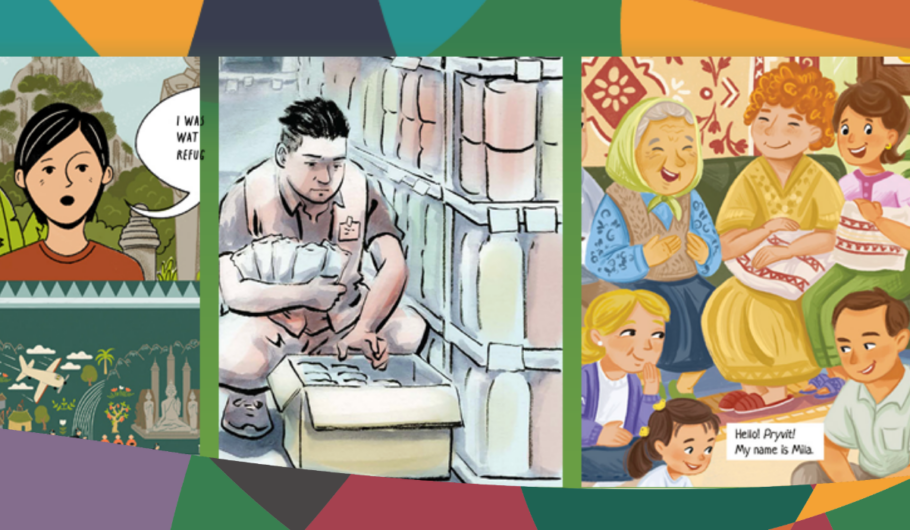
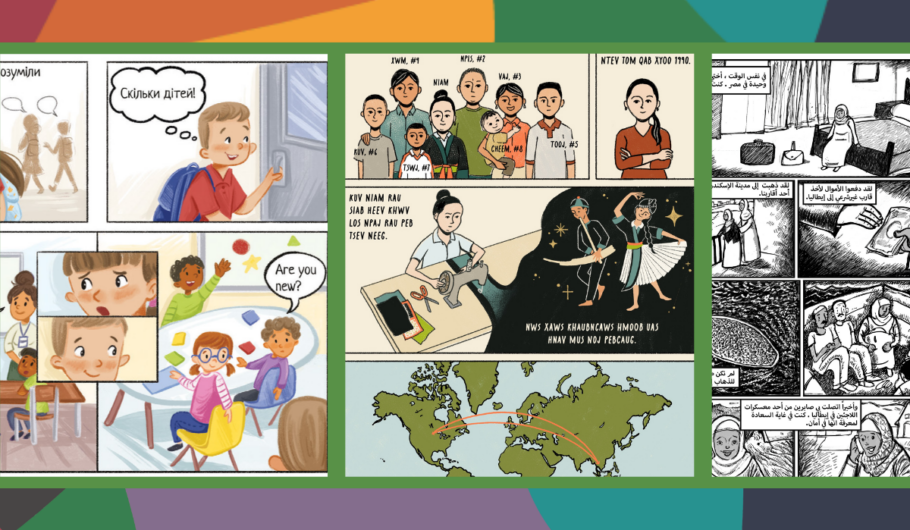
Lesson 1: Concept-Based Inquiry of Background Knowledge
Activity 1: Carousel Brainstorming
Materials:
- Chart paper (5 sheets)
- Markers (variety of colors)
- Tape or glue
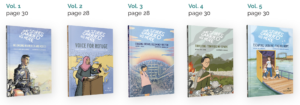
- Five copies of the selected Children’s Bilingual Graphic Novel texts or one of each
- One photocopy of the book covers (in both languages)
- Music (optional)
Set Up:
Make space in the room to hang the concept charts, the Frayer Models, and the taxonomy for visual support and learning throughout the unit.
1. Prepare Charts
Create a large circle on the paper, leaving room outside the page for writing. Think of it like a large rectangular edge with a circle inside. Use five large sheets of paper (chart paper is best) and multiple markers of a variety of colors. Place a photo of the book cover (both sides) in the center, glued or taped down.
2. Introduce the Activity
Ask the class if they are familiar with carousels, like merry-go-rounds at a park. Then explain that we are going to be reading one of five graphic novels written and illustrated by young people from one of five different countries. Each story will share how they came to live in the U.S. (or Minnesota).
Before we read, it’s important to understand what we already know about each story, country, or storyteller. This is called background knowledge.
Be direct about expectations for movement, voice levels, movement type, and waiting for a table to open up. All expectations are individual for each teacher’s personality and style.
3. Carousel
The teacher will say “GO!” or play music (or both) to indicate the start time. Students will circulate the room “carousel style.” When the teacher gives a signal, or the music stops, students stop at a table of their choice. They will look at the picture on the paper and the physical book standing in the center. THINK first about what you see just from the cover. Next, write a word or short phrase about what you think the book might be about. On the outer edge of the paper, outside of the circle, write down any questions you have about the text. Students walk around the classroom to visit each table, adding onto ideas, or they may choose not to. The goal is to circulate, to see what background knowledge appears, and to build on the learning of others in the process.
4. Whole Group Share
When students have visited all five tables, return to their seats. Take one table’s paper at a time and ask the class to share out what they predict anything they can about the story we’ll read. Use the paper to keep any questions visible to students and revisit and add to this poster/ paper throughout the unit.
Activity 2: Frayer Model Group Project
Start at the end of this activity and use it as an entrance to the next class if needed.
1. Select & Define Key Concepts
From the 18 concepts listed in the chart, choose the concepts from your Children’s Bilingual Graphic Novel series. Example, Vol 1 – Daniel’s story lists: Voluntary, Involuntary, Remittance, Reunify.
Students work in groups of 2-4 to define all concepts. Groups will work together to create a Frayer Model for each concept. Frayer Models are strong strategies for comprehension of new vocabulary words.
They include four parts:
- vocabulary word definition
- illustration Definition Visual/Image Word used in a sentence or two Word/ Concept Non-Examples, antonyms • original sentence or phrase
- non-example or antonym
Introduce Frayer Models in advance of this lesson if students are not familiar with them. Feel free to alternate the antonym box with another skill per your class needs (e.g., word roots or prefixes).
Group roles: writing, drawing, researching definitions and non-examples using Children’s Bilingual Graphic Novel series, and making the poster look beautiful.
2. Reflect & Build Vocabulary Taxonomy
Wrap up the lesson. Introduce the taxonomy for the unit. Start by adding the concepts the students just defined. Ask: Why might this be a helpful strategy when learning about new words? Elicit ideas for any new words to add.
Use the taxonomy for all words, terms, posted, and visible A-Z. Create a group chart and/or print the handout and use it in notebooks or both! Leave blank at the start, then add words as you go through the unit. Use different colors each time you add words. Choose students to add to the taxonomy.
Lesson 2: Building Vocabulary
Activity 1: New Vocabulary
1. Introduce & Engage with Vocabulary
Introduce the words before passing out handouts. Show the words on the classroom screen. Then, call-and-response style, read each word aloud, followed by the students reading it together.
Be sure to ask for student noticings. Example: “I see the prefix “re” which means again, back, or anew.” Discuss any root word parts as you read them. Example: “Unify means to make one.” After each word has been read by the class, introduce a reading strategy for the definitions, called “Jump In” (Dr. Hollie, CLLRT). The strategy is easy to implement.
After each word is read, one brave soul will “jump in” to read the definition.
This speeds up time, increases participation, and eliminates calling on students with their hands raised.
Activity 2: Matching with Pairs
1. Match Vocabulary Terms and Definitions
Using the vocabulary handout from your story, cut out the terms and definitions (in advance) and keep them organized into groups. Use an envelope to store them for other classes. You will need one set for every pair of students.
Let the kids “play” with the words by matching each term to its definition. Switch partners if time permits for a second round.
2. (Optional)
Organize by Story When all pairs have matched the terms, push them to try to organize by story/ storyteller. Daniel’s words You can give the hint by writing on the board by the number of terms per story:
- Vol 1 – Daniel’s story = 4
- Vol 2 – Zaynab’s story = 6
- Vol 3 – Kim’s story = 5
- Vol 4 – Thai’s story = 5
- Vol 5 – Mila’s story = 4
Activity 3: Find Your Match
Materials:
- Notecards (Prepared in advance)
1. Prepare the cards
Either the teacher creates or has a few students do this. Get one notecard or ½ sheet of paper for each vocabulary, concept, and each definition.
If you only have 10 terms + 10 definitions but 24 students, throw in an extra fact or any new term from the story, e.g. the name of a food, or a country. There must be an even number; everyone needs one card. Pair up students or one trio if there are uneven numbers.
Write legibly for each card.
2. Distribute Cards
Once the cards have been written out (or shortcut: enlarge the handout, print, and cut out), pass out one card to each student.
3. Find Your Match
When the teacher gives a signal, students get up from their seats and try to find their “match.”
When a “match” has been found, students will stand together with their partner, raise their hands, and move to the outside of the class to form a circle.
Do this until all matches have been found. They can help each other if they get stuck.
4. Share Out
Regroup as a circle and go around, asking each pair to read their word and definition to the group.
Bonus: Read your partner’s card to the group. Introduce your partner: This is Tea, and her word is “reunify.”
Partner: This is Yasmin, and the definition of “reunify” means to get back together.
The teacher collects each card after they’ve shared out for use with the next class.